
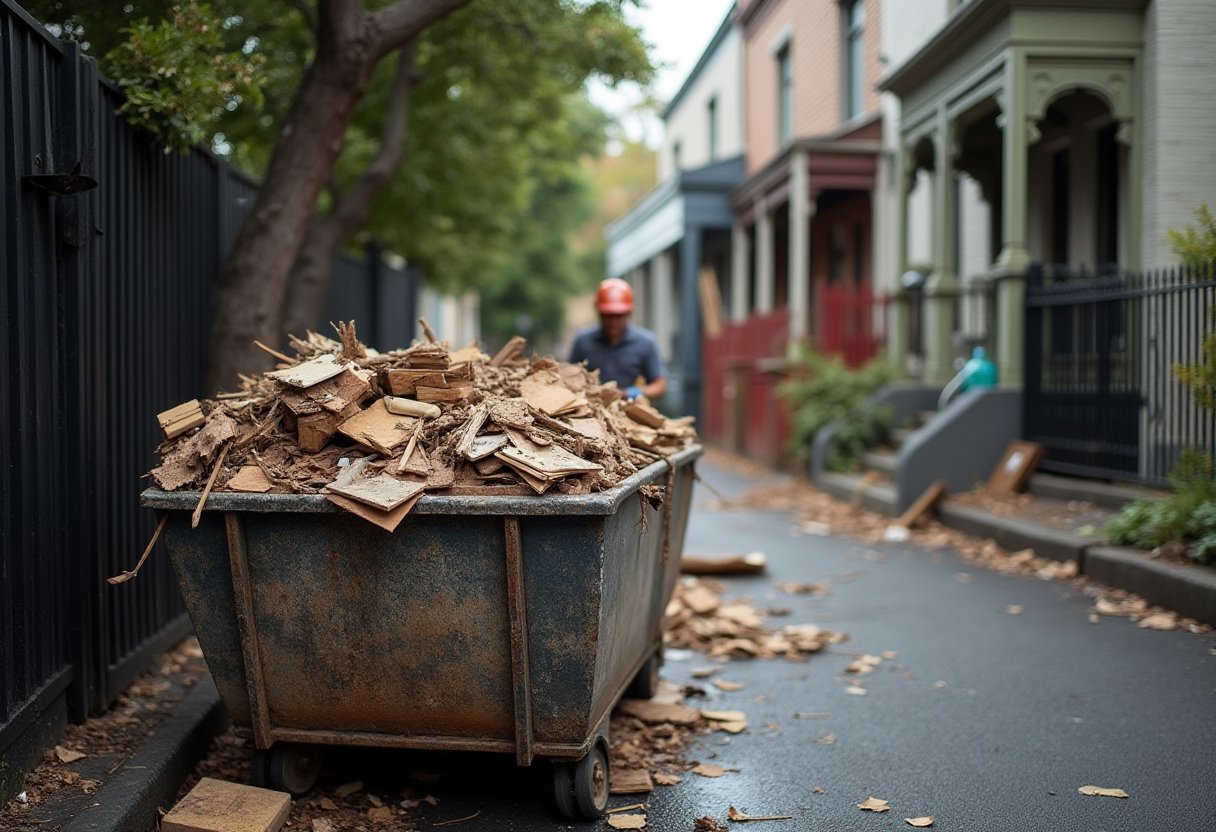
Make safe strip out rubbish removal Melbourne jobs live and die on one thing: how fast the debris actually leaves the property. When a burst pipe or a fire has taken a ceiling out on a Toorak terrace, the make-safe crew can only work as fast as the waterlogged plaster, carpet and insulation can be cleared from the room. On a wide suburban block with off-street parking, a permitted skip on the verge is fine. On a narrow inner-Melbourne street with zero off-street space, that same skip can sit on a council waiting list while your crew steps around a growing pile in the hallway. The choice between the two isn’t a formality. It’s usually what decides whether the site is clear by the end of day one or still blocked on day four.

Why the skip becomes the critical path (council permits)

Here’s the bit that catches a lot of restoration crews out: the skip bin permit, not the make-safe itself, ends up setting the pace of the job.
Most inner-Melbourne councils treat a skip on the road the same way they’d treat any obstruction on a public asset. City of Melbourne says a skip must not go on the road until a permit has been issued, and it only accepts that application from an authorised representative of the company that owns the skip. Port Phillip spells it out the same way: the permit must be obtained by a registered skip bin supplier before a bin goes on a road or council land. Prahran, South Yarra and Toorak sit in Stonnington, which also requires a permit for a skip on council land. So the sequence isn’t yours to drive. You don’t lodge the application, your skip supplier does, and the lead time you’re carrying is theirs. On a job with a two-week window that’s a non-issue. On a make safe strip out rubbish removal job in Melbourne that insurers are pushing to close fast, it’s a genuine bottleneck.
The geography makes it worse. A lot of these terraces in Prahran, Richmond, Fitzroy and Collingwood were built for horses and carts, not skips. There’s often nowhere to put one without blocking a lane entirely, which triggers extra approvals and a longer wait again.
So the permit isn’t a paperwork formality you tick off in the background. It’s a scheduling decision that either lines up with your make-safe window or fights against it. If the permit’s already sitting with council and the street’s wide enough to take the bin, great, that’s the cheaper option and it’ll usually get there. If you’re on a narrow strip with an urgent make-safe and no permit in hand, that’s the moment to stop waiting on council and get a removal crew booked instead, because the debris still needs to be gone before anyone can assess what’s underneath it.
Sorting the load (general waste vs reportable priority waste)
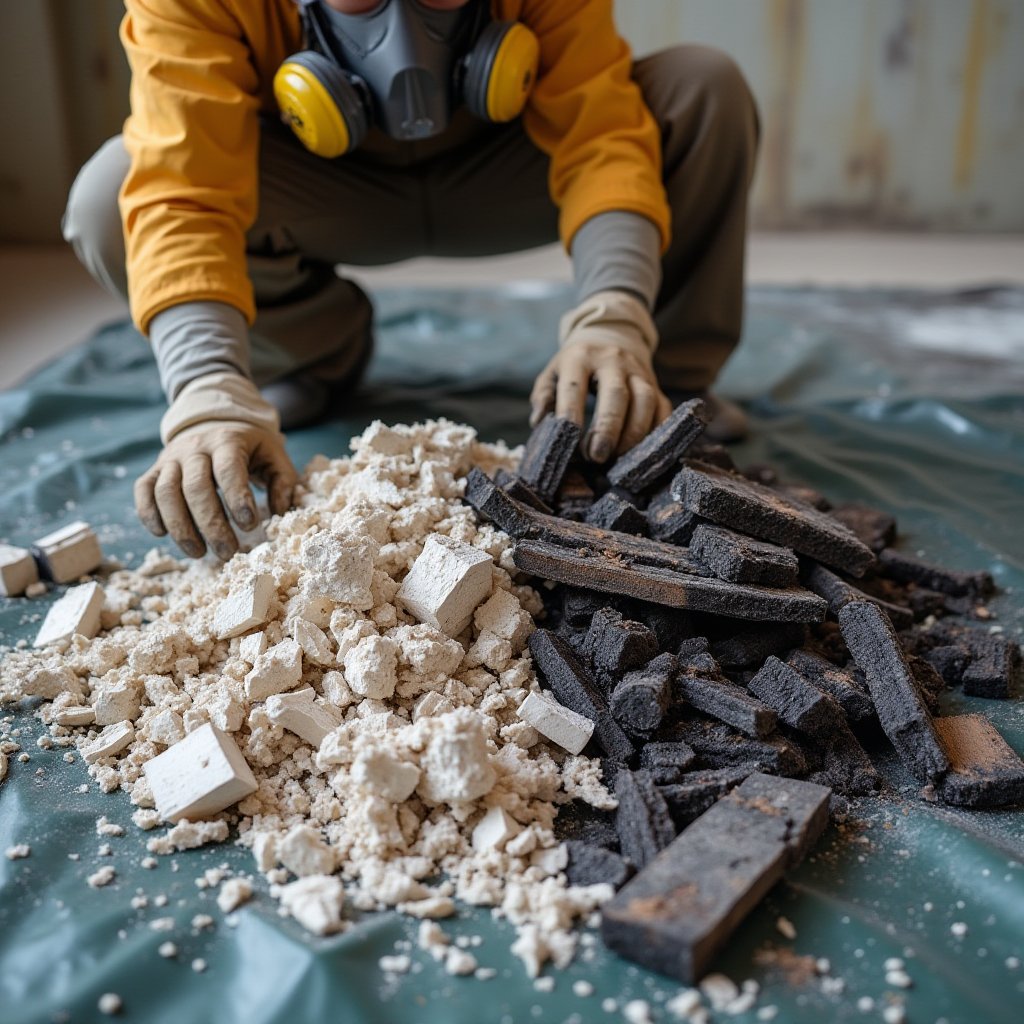
Before anything leaves site, someone needs to look at what’s actually in the pile. Most strip-out debris, plaster, timber lining, old carpet, water-damaged skirting, is general waste and goes wherever’s quickest. Soaked carpet is its own call, and we’ve set out how to handle water-damaged carpet separately. But a strip-out after a fire or a burst pipe in an older Toorak or Hawthorn place can also turn up material that isn’t general waste at all.
Fire debris is the one that catches builders out. EPA Victoria’s line is that waste from a fire may be industrial waste, and some of it is pre-classified as reportable priority waste that you need a permission to transport, because burnt building material can carry contaminants that ordinary tips aren’t set up for. If your make-safe follows a house fire, that debris needs to be identified and kept separate before it goes anywhere, not bagged in with the general strip-out and sent off in the same load.
The other one worth knowing is asbestos. A lot of the terraces we work around in Prahran, Richmond and Fitzroy still have old eaves lining, vinyl flooring or fibro underneath a bathroom that was never touched at renovation. If a strip-out disturbs any of that, EPA pre-classifies it as reportable priority waste under Schedule 5 of the Environment Protection Regulations 2021 and it can’t go out with your general rubbish removal, full stop. It needs its own licensed handling, and every time it changes hands the transaction has to be recorded in EPA’s Waste Tracker.
This is where sorting on site actually saves you time, not just compliance headaches. A crew doing a make safe strip out rubbish removal job in Melbourne’s inner suburbs should be splitting the load as it comes off the wall or floor, general waste in one pile, anything that might be fire-affected or asbestos-suspect set aside untouched. Get that split right at the start and your on-call removal can take the general waste straight off site while the priority material gets assessed properly, instead of the whole job stalling because one contaminated batten held up everything else.
Sequencing removal around the assessor’s sign-off

Here’s where a lot of restoration jobs lose a day they didn’t need to lose. The assessor turns up expecting to see the affected area intact enough to confirm scope, but the strip-out crew has already ripped everything down and it’s sitting in one undifferentiated heap by the skip. Now nobody can say with confidence what’s general waste and what needed to be flagged before it left the property.
The fix is sequencing, not speed. Strip out in stages that match what the assessor actually needs to see: expose the damage, photograph it, get initial sign-off on scope, then remove. If the make-safe strip-out turns up anything that might land in EPA’s priority or reportable priority waste tiers rather than plain industrial waste, that material sits aside, untouched, until it’s been assessed and correctly classified. Everything else, the general waste, moves straight off site on the on-call removal without waiting on the rest of the paperwork.
This matters more on a Prahran or Richmond terrace than it would on a job with a driveway and room to stage. There’s nowhere to store a “maybe” pile for three days while emails go back and forth. Either it clears the footpath quickly or it becomes the thing tripping up the site.
Talk to your removal contractor before the strip-out starts, not after. Tell them roughly when the assessor’s visit is booked and what stage the material needs to be at. A crew that’s done this before will time the load-out around that sign-off instead of working against it. Once the trades move back in, the final clear is a different job again, and we’ve written about post-construction cleanup separately.
Skip permit or on-call removal for time-critical jobs
A council skip permit is fine when you’ve got the time and the footpath to spare. Apply, wait for approval, book the bin, get it delivered, fill it, get it collected. On a job with a fixed make-safe window, that sequence is the problem, not the solution. Melbourne, Port Phillip and Stonnington each run their own approval process, and none of them is built to turn around in a day. We’ve compared a skip bin against a removal service for ordinary jobs, but on a restoration job the clock changes the answer.
For a genuine make safe strip out, rubbish removal in Melbourne’s inner terraces usually goes better with an on-call crew working off private property. That holds for houses and for shop and office strip-outs alike. No permit to wait on, no bin sitting on a strip of road too narrow for the neighbours’ cars to pass, and load-out happens when the material is ready, not when council paperwork clears. It’s the difference between debris off site on day one and still sitting there on day four while an assessor tries to work around it.
There’s a condition attached, though. On-call removal only moves fast if the load has already been sorted into general waste. If there’s any suspicion of asbestos sheeting, contaminated insulation or anything else that needs classifying, that material needs a licensed handler before a general rubbish crew touches it. Mixing the two doesn’t just slow the job down, it puts the whole load-out at risk of being knocked back.
There’s a cost tail to it as well. Once priority waste is headed for landfill it gets sorted into one of EPA’s six disposal categories, and that category sets the waste levy, which is a big part of what the tip charges you.
Decide early which category you’re dealing with, and choose the removal method to match. On a tight make-safe timeline, that one call is what keeps the strip-out moving instead of stuck at the kerb.
Frequently Asked Questions
Usually, yes. Prahran and South Yarra are both in the City of Stonnington, and Stonnington requires a permit for a skip bin on council land, the same as most inner Melbourne councils. Terrace streets rarely leave you room to keep the bin on private property instead. The part people miss is that you don’t apply for it. Both Stonnington and Port Phillip only accept an application from the skip bin company, so their lead time becomes yours, and Stonnington is currently flagging an unusually high volume of permit requests and delays in responding to them. That’s fine for a scheduled reno and a problem for a make safe. It’s exactly what pushes builders towards an on-call removal instead.
General waste covers plasterboard, timber, carpet and general demolition debris, and it can go straight into a bin or truck for rubbish removal. Reportable priority waste includes things like asbestos, contaminated soil or specific chemical residues, and EPA Victoria requires it to be tracked and disposed of through a licensed pathway, not general rubbish removal. Before any strip-out material leaves site, someone needs to look at it and classify it correctly. Get this wrong and you risk delays, fines or a load being rejected at the tip, which defeats the whole purpose of moving fast.
Yes, and on a tight timeline that’s often the point. A crew can pull material off site in stages as the make-safe team clears each room, rather than waiting for the whole job to finish before booking one big clearance. This works well on narrow terrace blocks in Richmond or Fitzroy where there’s nowhere to stockpile debris without blocking access for trades or neighbours. It does mean coordinating timing with the site supervisor so removal doesn’t get in the way of the actual make-safe work.
For a short, urgent job, generally yes. A skip permit adds a booking and approval step before the bin even arrives, then you’re waiting again for it to be collected once full. An on-call service can be booked ahead for next-day access, load straight from wherever the debris is sitting including inside the property, and take it away in one visit. For a long strip-out with easy street access and no time pressure, a skip is still the cheaper, simpler option. The call comes down to how much the timeline actually matters.
On an insurance job, this is usually flagged by the assessor, the restoration builder or a licensed asbestos assessor if the property’s age or damage suggests a risk. EPA Victoria says houses built before 1990 are likely to have some asbestos present, so anything of that age in suburbs like Hawthorn or Kew warrants a proper look before demolition debris is touched. Our team isn’t licensed to remove asbestos or other reportable priority waste, but we’re used to working alongside the trades who are, and we’ll only take general waste once it’s been given the all clear. If you’re planning the sequencing on a make-safe, it’s worth locking that classification step in early so it doesn’t hold up the rest of the job.